This goes hand in hand with my Underwriting Submission post, which I suggest checking out. It covers an Account Summary, which provides high-level exposures, a concise list of operations and notable details (e.g. safety program). At the risk of sounding like a one-trick pony (don’t worry, I’m not), this post covers why a good Loss Summary can be more valuable.
Why a loss summary matters
Sure, it helps speed up the submission process (quoting or decline). More importantly, it could be your only opportunity to guide an underwriter’s perception of the account.
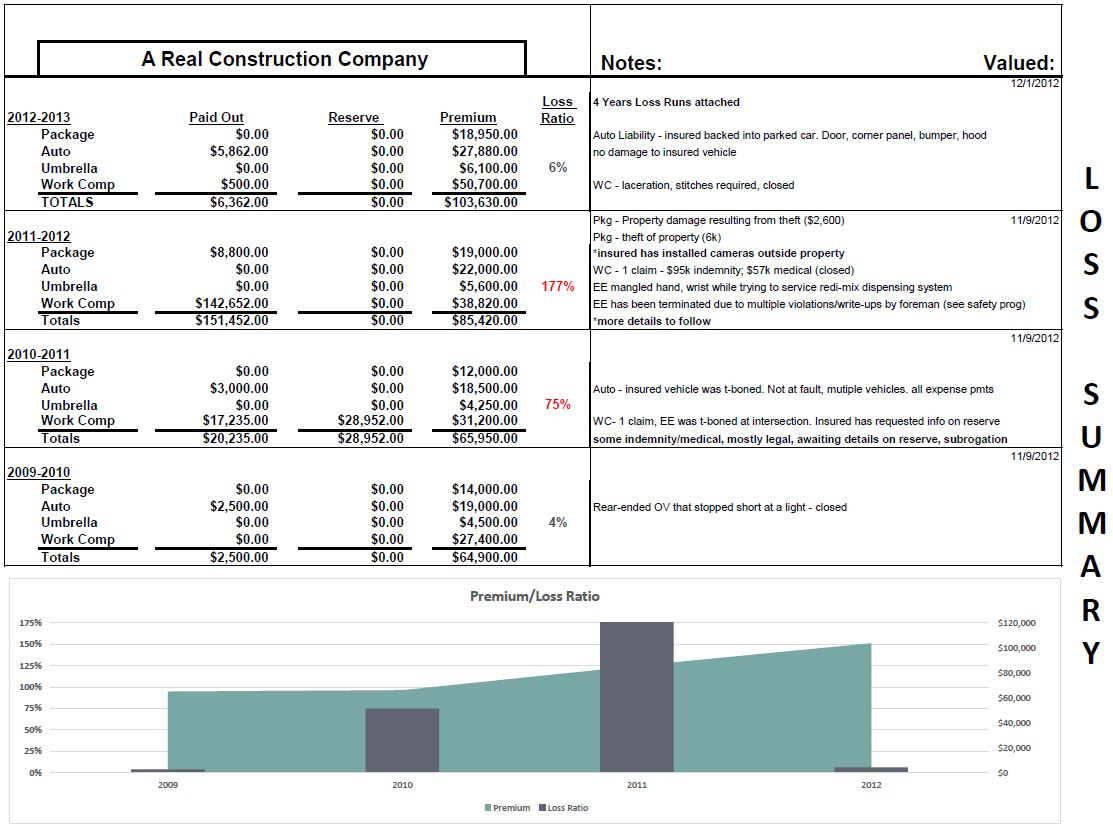
Check out my loss summary below, exactly as I used it seven years ago.
What makes it work
Four years of premium history
I rarely had more than two, but a 75% loss ratio was believable, and combined with year four’s premium it makes a 177% loss ratio from the prior year much more palatable. No one is questioning premium history unless it’s a specialty line and/or E&S (or you, the producer, have lost your credibility).
Descriptions and a valuation date for every term
Some descriptive basics and ‘more details to follow’ go a long way in keeping a deal alive and dialogue going. Maybe the carrier doesn’t list anything if there were no losses during a term (WTF Erie), which is why it’s a good idea to list a valuation date for each term represented in your summary, so the underwriter isn’t left wondering if you’re missing a year.
Built once, reused by line
What I’m not showing you is that everything except the notes transfers to a WC-only and Package/Auto-only Loss Summary, along with a corresponding graph, so I didn’t have to reinvent the wheel. I would present it both ways to Package markets and submit the WC to our mono-line markets.
The premium/loss ratio graph was optional. In this case it painted a good picture, but if it doesn’t, just delete it (as I probably did for the WC).
Keep it to one page
“Simplicity is the ultimate sophistication.”
Attributed to Da Vinci but of unknown origin, it’s a maxim used by Regis McKenna of Apple (1977) and, in this case, ironically embodied by a Microsoft Excel spreadsheet. Everything the underwriter needs to know about the loss history, on one page, curated by you.